

Cloud environment
Control how much outbound network access the Coding Agent's isolated cloud environment gets, from a built-in allowlist to a fully custom domain list.
The Coding Agent runs in an isolated cloud environment when it works on a task. The Cloud environment settings page controls how much of the outside internet that environment can reach while it runs — for example to install dependencies or call an external API.
This is a company-wide setting. Only Company Admin can change it, and the policy you pick applies to every cloud agent run in your company.
To open it, go to Manage → Cloud environment or visit hub.meetandy.ai/manage/cloud-environment.
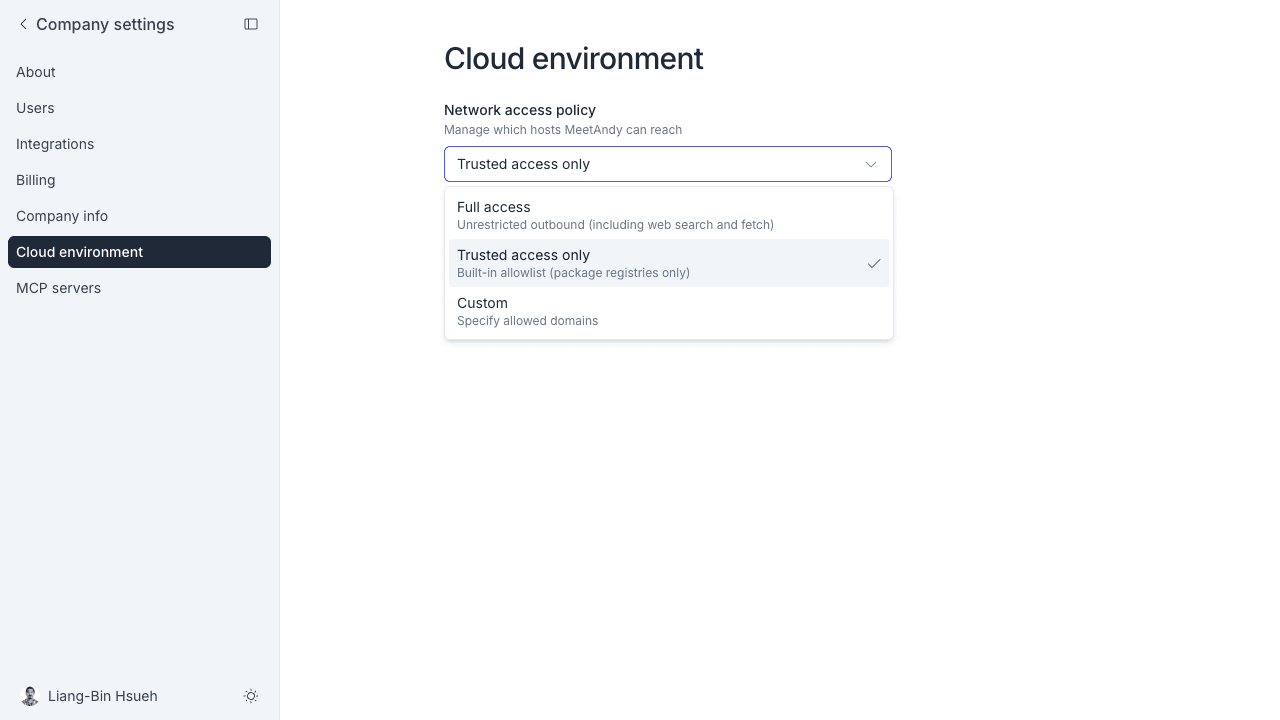
Network access policy
Trusted access only
The agent can reach a built-in allowlist of common, well-known services (package registries and similar) that most tasks need. Anything outside that list is blocked. This is the safest default and works for the majority of tasks.
Full access
The agent gets unrestricted outbound network access. Choosing Full access also enables web search and fetch, so Andy can look things up and pull in pages from the open web while it works.
Custom
You provide your own list of allowed domains. The agent can reach the domains you list and nothing else. Use this when your tasks need a specific internal or third-party service that isn't on the built-in allowlist, without opening up the whole internet.
Full access removes outbound network restrictions entirely. Anything the agent or the code it runs can reach over the network becomes reachable, including arbitrary external endpoints. Prefer Trusted access only or Custom unless you specifically need open web access, and review the change with whoever owns security at your company first.
Custom mode: domain format
When you select Custom, enter one domain per line in the Allowed domains box. Each entry must follow these rules:
- Bare domain only — no protocol, no path, no port. Write
api.example.com, nothttps://api.example.com/v1orapi.example.com:443. - Wildcard — one
*is allowed, but only as the leftmost label:*.example.com. A bare*or a wildcard in any other position is not accepted. - IPv4 addresses are accepted (for example
192.168.1.10) — useful for internal self-hosted services. - Single-label names like
localhostare not accepted. Use the loopback IP127.0.0.1instead. - Each entry is limited to 253 characters.
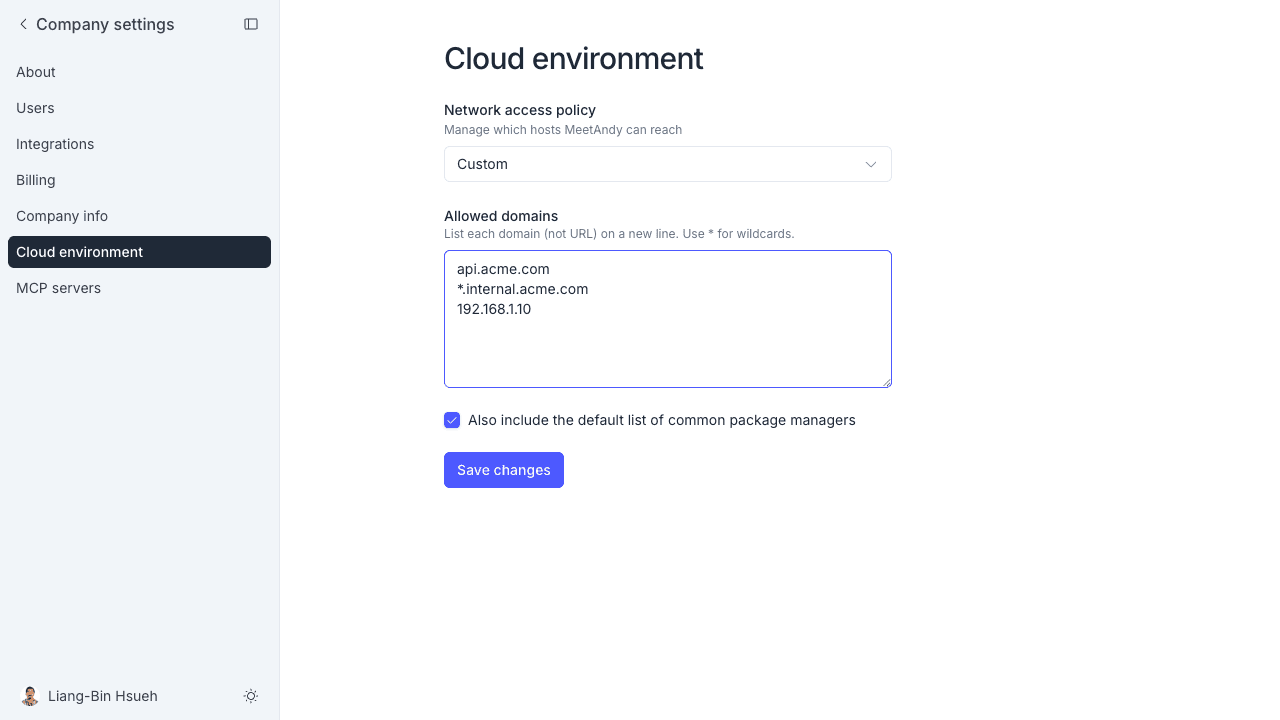
Also include the default list of common package managers is a checkbox below the box. Check it to also allow everything on the built-in Trusted allowlist. This lets you add a few specific domains on top of the standard package registries, without having to list every registry yourself.
Choosing a mode
- Start with Trusted access only. It covers most tasks and keeps the blast radius small.
- Move to Custom when a task needs one or two specific domains that the built-in allowlist blocks. Add just those domains, and check "Also include the default list of common package managers" to keep standard registries accessible.
- Use Full access only when you genuinely need open web access (for example, to let Andy research with web search and fetch), and you accept the security tradeoff.
You can change the policy at any time. New agent runs pick up the current policy immediately.